18 al 27 de Septiembre
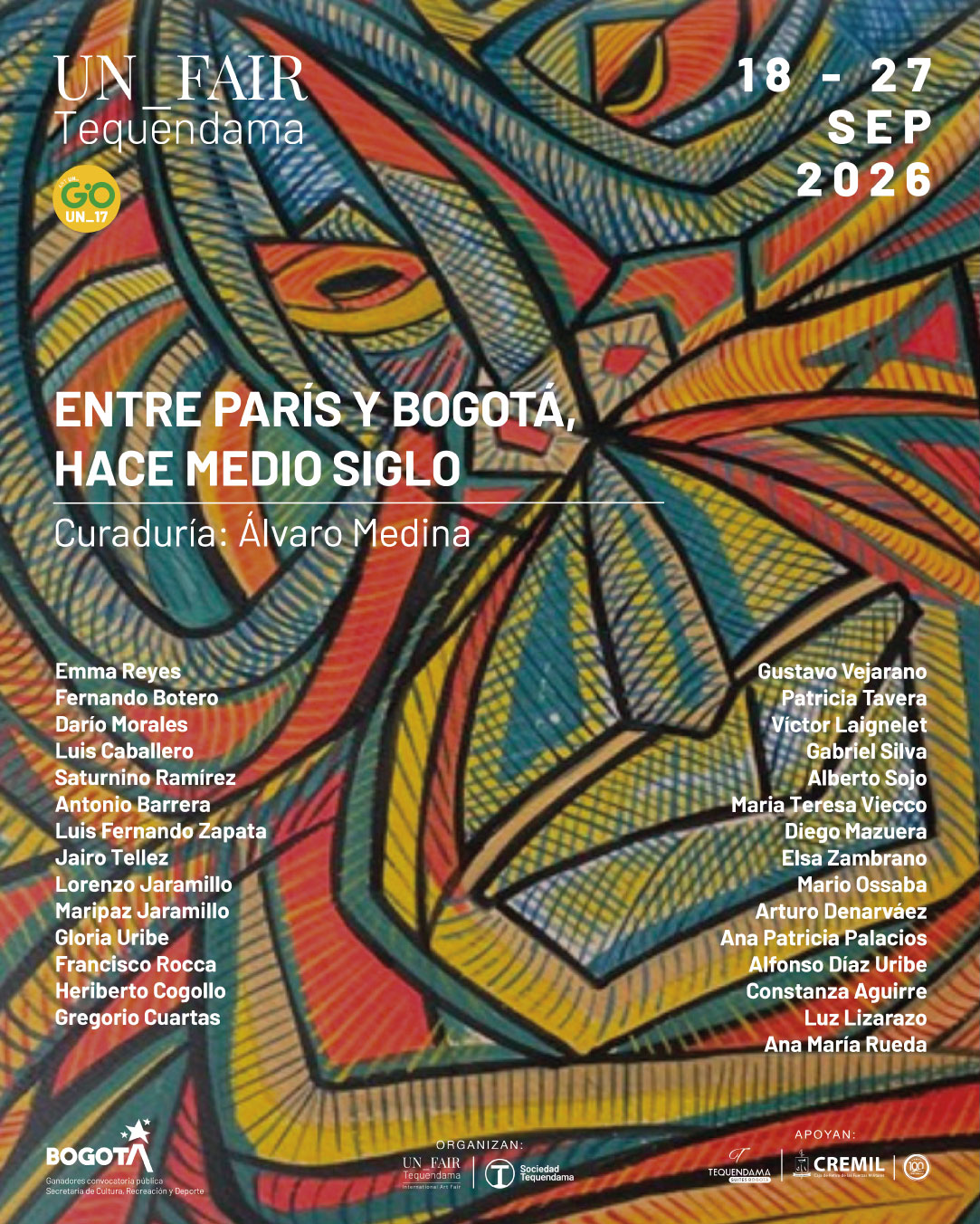
Entre Paris y Bogotá, hace medio siglo
Curatorship:
Álvaro Medina
Artists
Antonio Barrera
Alfonso Diaz
Alberto Sojo
Ana Patricia Palacios
Arturo Denarváez @denarvaezarturo
Constanza Aguirre
Darío Morales
Diego Mazuera @diegomazueragomez
Elsa Zambrano @elsa_zambrano
Emma Reyes
Gregorio Cuartas
Fernando Botero
Francisco Rocca
Gabriel Silva @gabriel_silva_rubio
Gloria Uribe
Gustavo Vejarano @gustavovejarano
Jairo Téllez
Lorenzo Jaramillo
Luis Caballero
Luis Fernando Zapata
Luz Lizarazo
Mario Ossaba
María de la Paz Jaramillo
María Teresa Viecco @vieccomariateresa
Saturnino Ramírez
Victor Laignelet @victorlaignelet
Since the late 19th century, the presence of Colombian artists in Paris has been a constant. They would study in academies, spend a few years in the City of Light, and return to their homeland. Beginning in 1963, that number grew significantly, this time as long-term residents. Their community eventually numbered around 30, including art critics and curators. Thanks to FIAC, they did not remain isolated; the quarterly journal Arte en Colombia and several Bogotá art galleries maintained an annual presence at the famous fair, building ties of communication and identity with Colombia, and above all, fostering warm encounters among the artists themselves.
Nearly the entire active diaspora established contact with Christopher Paschall and myself. Having had the fortune of working closely with these masters, Christopher became so familiarized with their work t hat he eventually became an art dealer. As for me, I was invited to write catalogue essays for their solo exhibitions—which is why Christopher enlisted me to curate Entre París y Bogotá, hace medio siglo. In this exhibition, viewers can observe, artist by artist, one work from those years alongside a recent creation, with the exception of sculptors, those who have passed away, or artists we were unable to contact in time.
The 1980 Venice Biennale and the 1982 Documenta in Kassel conveyed the impression that the era of Conceptual Art was waning, eclipsed by the overwhelming presence of the Italian Transavantgarde and German Neo-Expressionism. While that shift proved to be an illusion, it had practical effects: Enzo Cucchi’s major 1986 retrospective at Beaubourg confirmed a favorable climate for painting—the dominant medium among the Colombian artists working in the Parisian studios honored in this showcase.
It is worth noting that each of these Colombian artists developed their own themes through personal stylistic variations and visual languages, categorized by their respective generations (three generations coincided here) and the year they settled in the French capital. Added to this was whether they had already forged their own poetic and visual universe prior to their arrival. Ultimately, all of them demonstrated strong artistic individuality.
These paragraphs do not detail the individual artistic nuances of each participant; some artists could not be located and invited to participate, while others were unavailable for the event as scheduled.
Such a concentration of Colombian artists in a major metropolis of the international art circuit has not been repeated since. The phenomenon began with the arrival of Emma Reyes in 1947, gained momentum with the arrival of Luis Caballero, Heriberto Cogollo, and Darío Morales in the 1960s, and peaked during the 1970s with the settlement of Fernando Botero, Jairo Téllez, Gloria Uribe, Francisco Rocca, Ignacio Gómez Pulido, Saturnino Ramírez, Gregorio Cuartas, María Teresa Viecco, Arturo Denarváez, Gabriel Silva, Luz Ángela Lizarazo, Alberto Sojo, Antonio Barrera, Lorenzo Jaramillo, Gilma Suárez, and Maripaz Jaramillo. This cultural migration reached its height in the 1980s with Marta Traba, Gustavo Vejarano, Tiberio Vanegas, Patricia Tavera, Víctor Laignelet, Elsa Zambrano, Diego Mazuera, Ana María Rueda, Constanza Aguirre, Mario Ossaba, Alfonso Díaz Uribe, Luis Fernando Zapata, Ana Patricia Palacios, Olga Lucía Jordán, and Carolina Ponce de León.
A tragic moment of that period was the Avianca plane crash near Madrid Airport on November 27, 1983, which claimed the lives of art critic Marta Traba, draftsman Jairo Téllez, and sculptor Tiberio Vanegas (who had recently turned to painting), resulting in the loss of the recent works of the latter two. Another event—fortunately a celebratory one—was the 1993 publication of Nuestros pintores en París, a journalistic book covering several of the artists gathered here, featuring photographs by Ignacio Gómez Pulido and Olga Lucía Jordán, accompanied by texts by Plinio Apuleyo Mendoza.